


1 Day / Flexible Multi-Day Options
10–12 Hours
Lunch included at Kuromon Market or Dotonbori district
Private air-conditioned vehicle — round-trip from Tokyo
Private group — just your party
Expert English-speaking Trip Manager


Tokyo is Japan’s future — Osaka is its soul. The country’s greatest eating city, its most unashamedly fun metropolis, and home to a castle that has dominated the skyline for four centuries. From a feudal fortress rising above cherry blossom moats to neon-lit canal streets overflowing with street food, takoyaki smoke, and the kind of noise that only a city this alive can make — Osaka is a completely different Japan, and one of the most exhilarating days you will spend in the country. Your private vehicle takes you there in total comfort, and brings you home when you’re ready.
Begin your day at the symbol of Osaka — one of the most recognisable and historically significant castles in all of Japan. Osaka Castle was originally constructed in 1583 by the legendary warlord Toyotomi Hideyoshi, the man who unified Japan after decades of civil war, who chose this precise spot on the banks of the Yodo River to build a fortress that would declare his absolute dominance to the entire nation. The castle’s five-story main tower soars above a vast stone base and double moat system, its brilliant gold ornaments and white plaster walls gleaming against the Osaka skyline in a spectacle that has barely changed in four centuries. Stroll through the surrounding Nishinomaru Garden — one of the finest cherry blossom viewing spots in western Japan, with the castle perfectly framed behind the blossoms in spring — before entering the museum inside the tower where your guide brings the extraordinary story of Hideyoshi, the Battle of Sekigahara, and the rise and fall of the Toyotomi clan to vivid life.
Leave the castle and enter Osaka’s most famous and most beloved food market — Kuromon Ichiba, known affectionately by locals as “Osaka’s Kitchen.” Over 170 stalls stretch the length of a covered arcade that has been feeding the city’s chefs, households, and hungry visitors for nearly 200 years. The air smells of grilled seafood, freshly sliced tuna, and warm dashi broth before you are even through the entrance. Browse glistening mounds of spiny sea urchin, massive Hokkaido scallops, live crabs, wagyu beef skewers sizzling on open grills, and every variety of Japanese street food imaginable. Your guide will navigate the market with expert knowledge — pointing out which stalls draw the longest local queues, what’s in season, and what you absolutely must try. Lunch here is one of the great eating experiences of Japan: fresh, affordable, extraordinary, and served with the cheerful directness that defines Osaka hospitality.
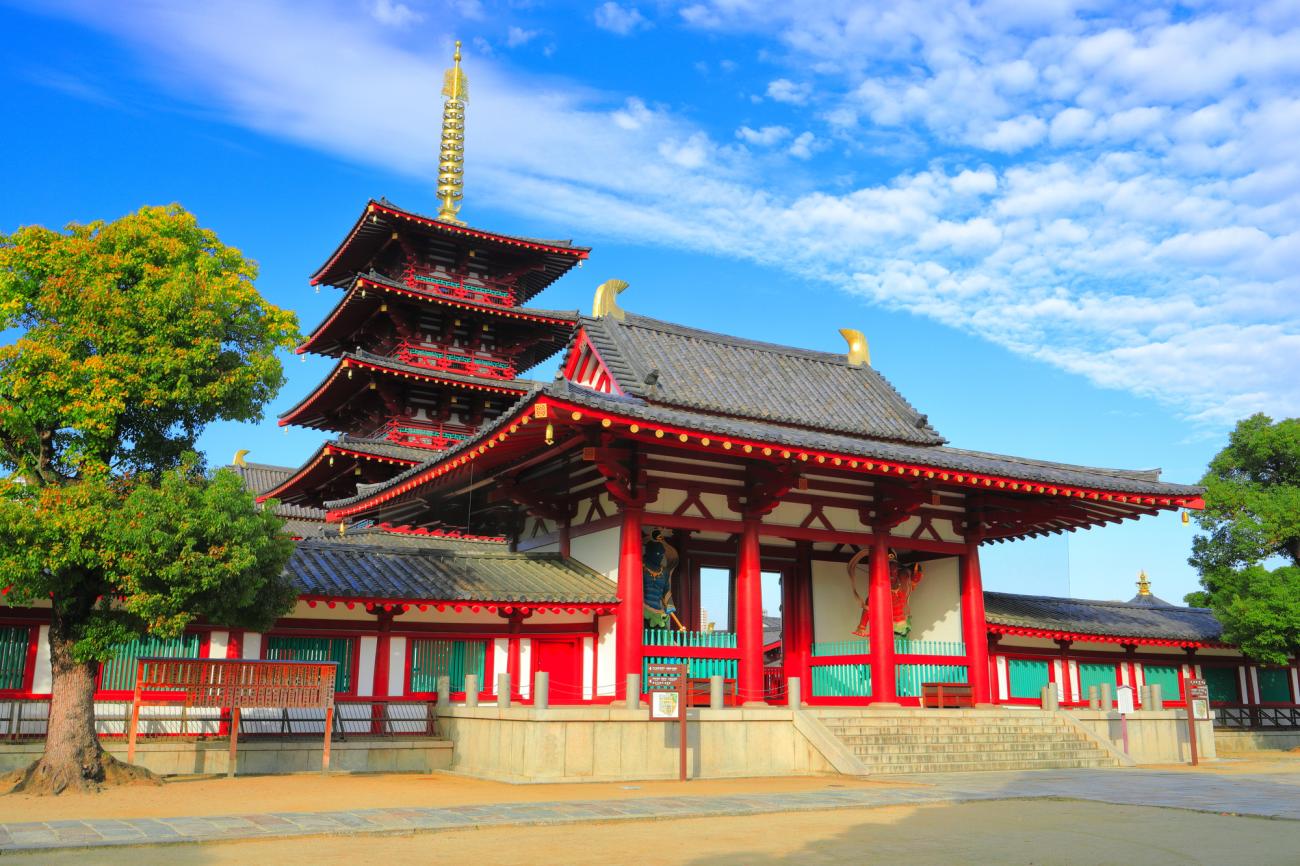
Step back over fourteen centuries to Shitennoji — founded in 593 AD by Prince Shotoku and widely regarded as the oldest officially administered Buddhist temple in Japan, predating Kyoto by two centuries. The temple complex is built on the original seventh-century layout with a stone torii gate, five-story pagoda, and golden hall arranged in the ancient continental style that Shotoku brought from China and Korea to civilise the Japanese islands. Despite centuries of fire and reconstruction, the atmosphere within the temple walls carries a profound sense of historical depth that even Kyoto’s most famous temples rarely match. The surrounding garden — Garan — is a place of extraordinary stillness in the middle of Japan’s second-largest city.
Travel south to Shinsekai — Osaka’s most distinctively retro and gloriously eccentric neighbourhood. Built in 1912 as a utopian entertainment district modelled on Paris and New York, Shinsekai today is a vivid, slightly anarchic parade of retro signage, kushikatsu restaurants, blowfish lanterns, and pachinko parlours that somehow creates one of the most atmospheric and photogenic streets in Japan. The neighbourhood centres on Tsutenkaku Tower — the Eiffel Tower of Osaka, built in 1956 and beloved by locals as the symbol of the city’s working-class south side. Try kushikatsu — the Osaka-born dish of breaded and deep-fried skewers of meat, seafood, and vegetables served with a communal dipping sauce — at one of Shinsekai’s legendary old-school restaurants, and observe the city’s most important culinary rule: never double-dip your skewer.
End your day in the place that defines Osaka to the world — the Dotonbori canal district, Japan’s most concentrated and most intoxicating strip of food, neon, and entertainment. The canal street blazes with enormous illuminated signs — the iconic running Glico man, the giant mechanical crab of Kani Doraku, blowfish lanterns, dragon murals — in a sensory spectacle that is unlike anything else in Japan. The waterfront promenade stretches along both banks of the canal where visitors stream past countless ramen shops, gyoza counters, takoyaki stands, wagyu beef restaurants, and Osaka-style okonomiyaki griddles. Your guide will lead you through the best of Dotonbori — pointing out the must-try street foods, the historic shops, and the photography spots that capture the full electric energy of Osaka at its most alive. Stroll the famous Ebisubashi Bridge over the canal as the neon reflections shimmer in the water below — one of the great evening scenes in all of Japan.
Before your return journey, ascend to the Floating Garden Observatory at the top of Umeda Sky Building — one of the most architecturally extraordinary buildings in Japan. Two forty-storey towers are connected by a spectacular rooftop observation ring suspended between them at 173 metres, reached by a glass escalator that rises through open air between the two structures. The 360-degree panoramic view across the entire Osaka metropolitan area — with the city stretching to every horizon, the Yodo River winding below, and the lights of the Kansai region spreading to the mountains — is one of the most breathtaking urban views in Japan. At dusk, when the city transitions from golden hour to full neon, it is genuinely spectacular.
Your private vehicle returns you directly to your hotel or preferred drop-off point in Tokyo, arriving comfortably by late evening.
Accommodation is not included in this day-tour package. We recommend staying in central Tokyo for a smooth morning departure. Interested in an overnight stay in Osaka? Contact us for hand-picked hotel recommendations in the Dotonbori, Namba, or Umeda areas — the heart of the city's best food and nightlife.
A certified, English-speaking tour guide accompanies you throughout the entire day — sharing deep knowledge of Osaka's feudal history, merchant culture, street food traditions, and the unique character of each neighbourhood. Osaka has a distinct identity, humour, and pace entirely its own, and your guide will help you understand and experience it fully.
All castle and temple entry fees for included stops. Real-time flexibility to adjust the itinerary around your group's food interests, energy, and pace — including optional additions such as the Cup Noodles Museum, Osaka Aquarium Kaiyukan, Sumiyoshi Taisha Shrine, or Namba shopping district on request.
Round-trip travel in a private, air-conditioned vehicle with door-to-door pickup and drop-off from your hotel anywhere in Tokyo. No shared buses, no fixed departure points — your comfort and schedule come first from start to finish.
International flights to Japan are not included. We recommend flying into Tokyo Narita (NRT) or Tokyo Haneda (HND).
Travel insurance is not included and must be arranged separately before departure.
Lunch at Kuromon Ichiba Market is the centrepiece of the day — your guide will lead you directly to the best stalls and help you navigate the market's extraordinary variety of fresh seafood, grilled skewers, and Osaka street food specialities. Additional snacks and drinks throughout the day — especially at Dotonbori — are very much part of the Osaka experience and are at your own expense. Carrying some cash is recommended as many market stalls and street food vendors do not accept card payments.
IMPORTANT NOTES
Don’t miss your chance to experience Japan’s hidden beauty with our expert local guides. Small groups fill up fast — secure your spot today.
Subscribe for latest news and Offers.

Copyright © 2026 Easy Trip Japan | All Right Reserved